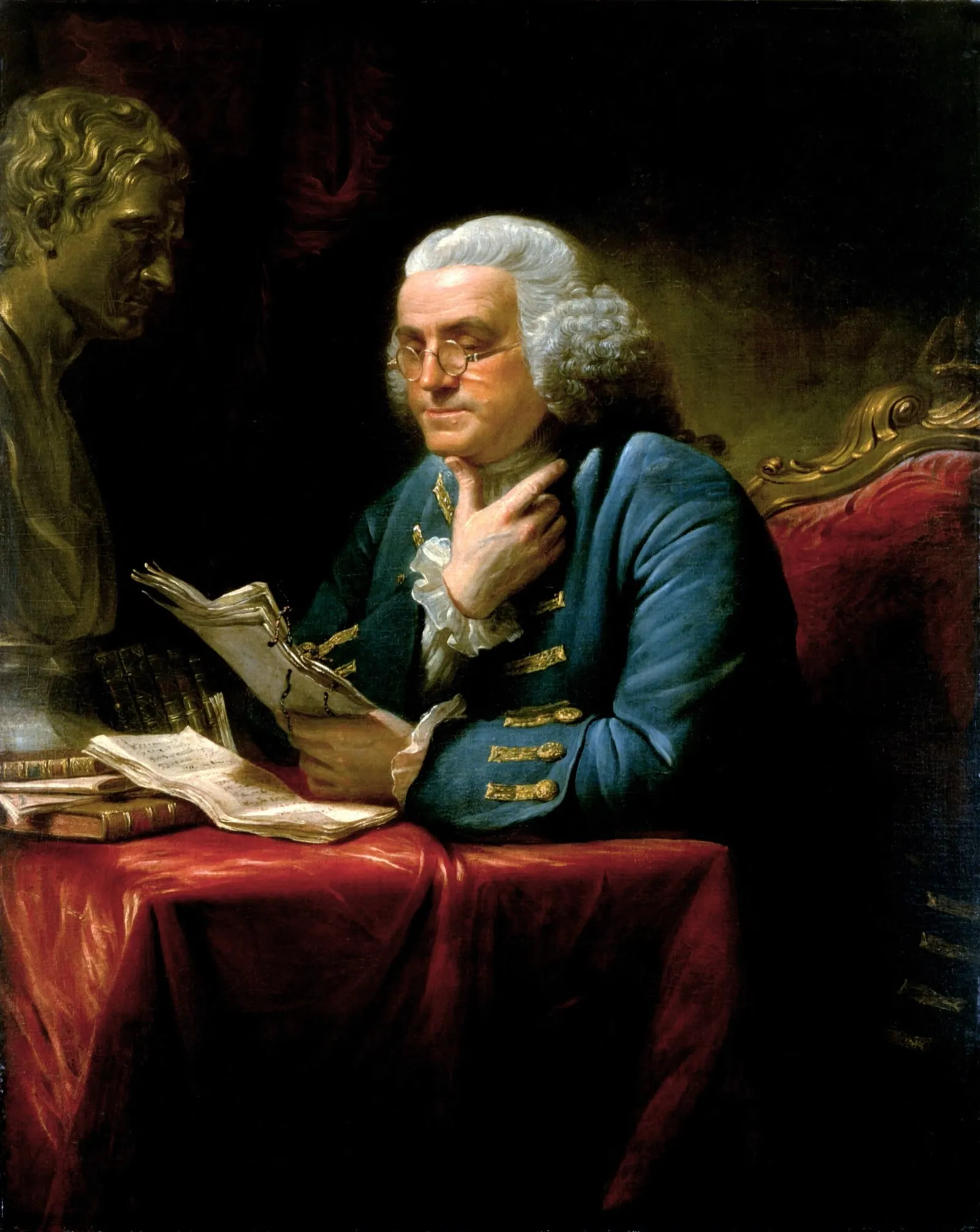
1706 — 1790

Benjamin Franklin

Printer. Scientist. Diplomat. Inventor. Philosopher.
The Universal Man.

Scroll to explore
Marble statue of Benjamin Franklin

No figure in American history embodies the possibilities of human potential more completely than Benjamin Franklin.

Born the fifteenth of seventeen children to a Boston candlemaker, he rose through sheer industry and insatiable curiosity to become the most celebrated American of his age—a man equally at home in the print shop, the laboratory, the diplomatic salon, and the halls of revolution.
Chapter I

The Printer's Art

At twelve years old, Franklin apprenticed to his brother James, entering the ancient guild of printers. Here he discovered his twin passions: the power of the written word and the mechanics of industry.

He did not merely learn to set type. He learned to think in ink, to understand that ideas, properly composed and distributed, could reshape the world. By twenty-two, he owned his own print shop in Philadelphia. By thirty, he published the most widely-read periodical in the colonies.

The Pennsylvania Gazette and Poor Richard's Almanack made him wealthy. But more importantly, they made him influential. Franklin understood what few of his contemporaries grasped: that the printing press was not merely a business but a technology of liberation.

Benjamin Franklin working in his print shop
The young printer at his press
"

An investment in knowledge pays the best interest.

Poor Richard's Almanack, 1758

Chapter II

Lightning & Reason

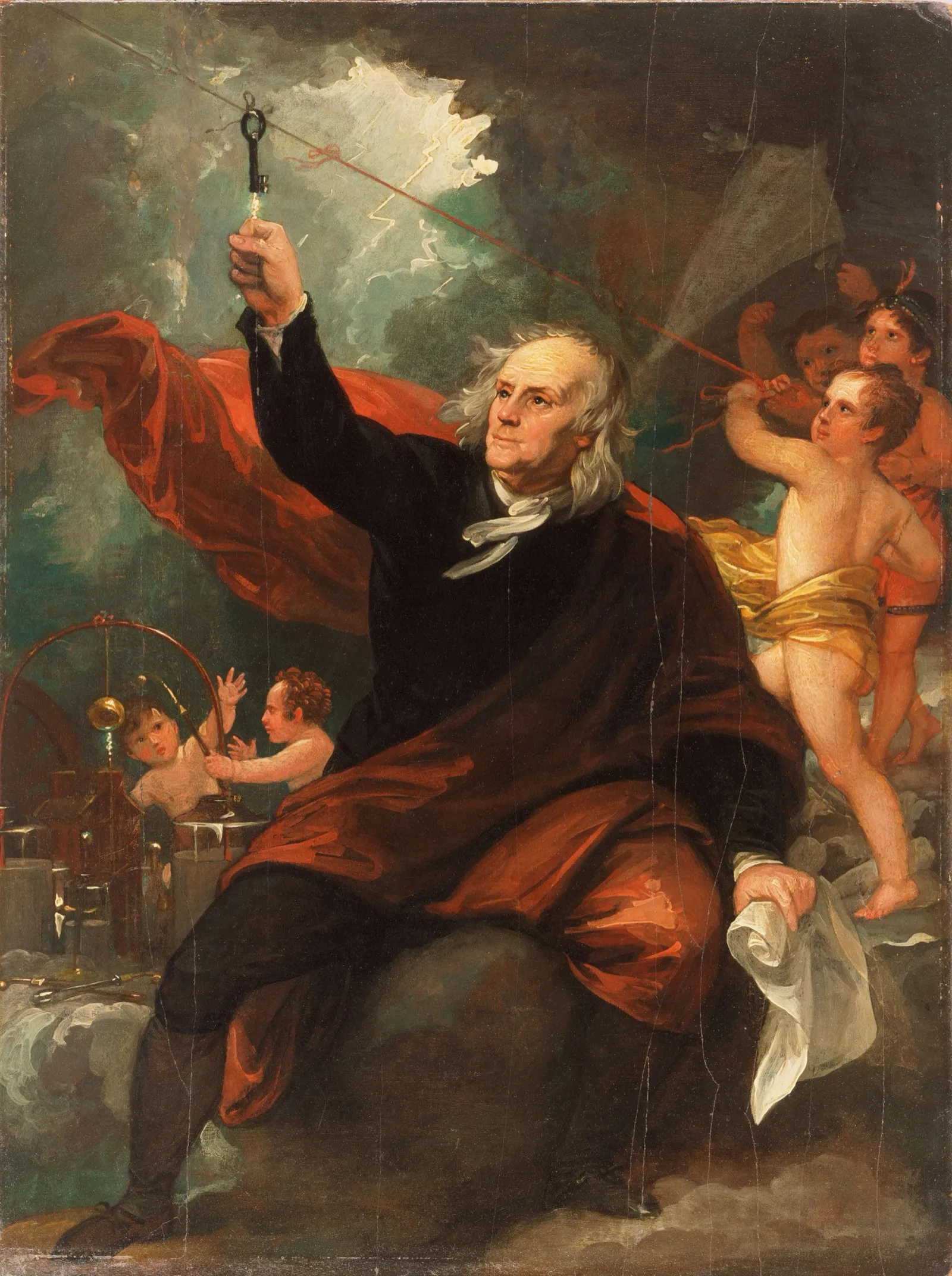
While other colonists feared the violence of thunderstorms, Franklin studied them. His famous kite experiment of 1752 did not merely prove that lightning was electrical—it demonstrated that nature itself could be understood, measured, and ultimately harnessed by human reason.

The lightning rod followed, protecting buildings across two continents. But Franklin's scientific contributions extended far beyond electricity. He charted the Gulf Stream, invented bifocal spectacles, designed a more efficient stove, and established America's first lending library.

Each invention emerged from the same source: an unwillingness to accept the world as given, combined with the practical wisdom to improve it. Science, for Franklin, was never abstract speculation. It was the servant of human flourishing.

Franklin's kite experiment with lightning
The kite experiment, 1752

His Contributions

A Diversity of Genius

Lightning Rod

Protected countless buildings from fire, saving lives and property across the world.

Bifocal Spectacles

Combined distance and reading lenses, a practical gift to aging eyes everywhere.

First Lending Library

Founded the Library Company of Philadelphia, democratizing access to knowledge.

Franklin Stove

A more efficient heating system that used less fuel and produced more warmth.

Postal Service

Reorganized colonial mail, creating an efficient system that connected a nation.

American Philosophical Society

Founded the premier learned society of the New World, fostering scientific exchange.

Chapter III

Ambassador of Revolution

At seventy years old, when most men sought rest, Franklin crossed the Atlantic to secure the alliance that would make American independence possible. In Paris, he became the most famous American in the world—a living symbol of the New World's promise.

The French adored him. Here was a man who had tamed lightning, who dressed simply among the powdered aristocrats, who embodied the Enlightenment ideal of reason applied to life. His diplomacy secured French money, French ships, and French soldiers—without which the Revolution would have failed.

When asked what he had done for his country, Franklin might have answered: everything. He signed the Declaration of Independence, the Treaty of Alliance with France, the Treaty of Paris, and the Constitution. No other Founder affixed his name to all four.

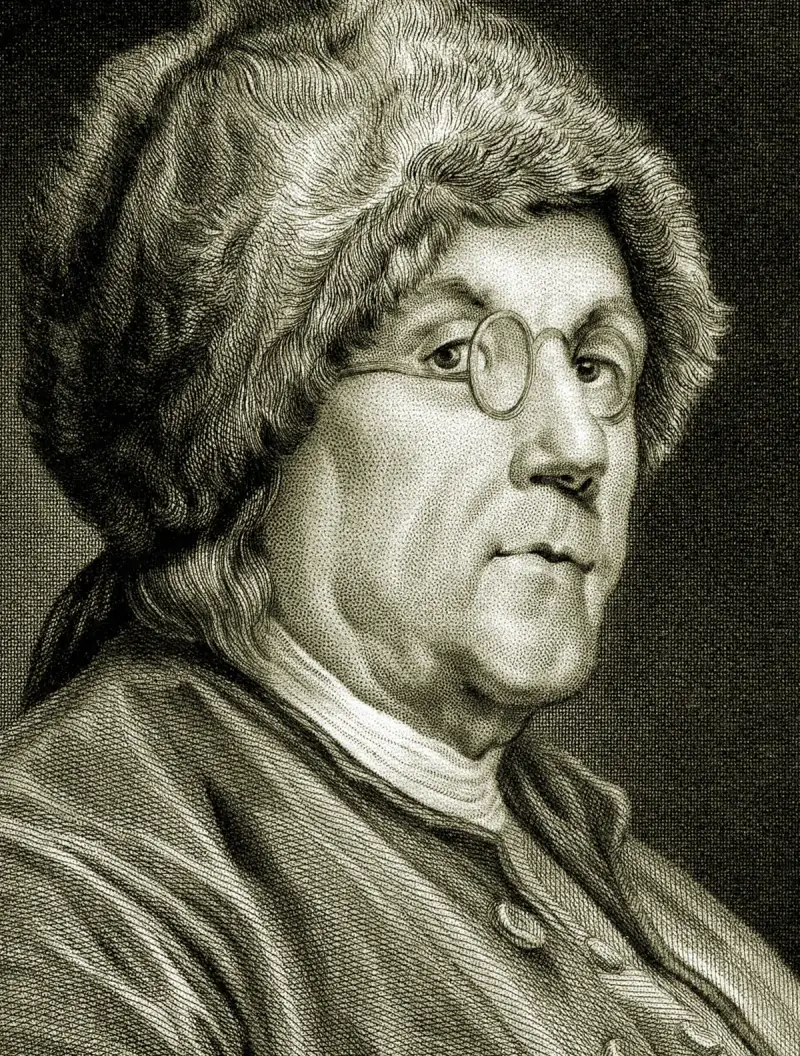
Benjamin Franklin in his famous fur cap
Franklin in France, wearing his iconic fur cap
"

Either write something worth reading or do something worth writing.

Poor Richard's Almanack

A Life in Time

The Arc of Industry

1706

Born in Boston, fifteenth of seventeen children

1718

Apprenticed to brother James as a printer

1729

Purchases the Pennsylvania Gazette

1731

Founds the Library Company of Philadelphia

1752

Conducts the kite experiment, proving lightning is electrical

1776

Signs the Declaration of Independence

1778

Secures the French Alliance

1787

Signs the Constitution at age 81

1790

Dies in Philadelphia, mourned by two nations

Chapter IV

The Ideal Human

What made Franklin remarkable was not any single achievement but their combination. He was not merely a printer, merely a scientist, merely a diplomat. He was all of these simultaneously—and more.

His famous thirteen virtues—temperance, silence, order, resolution, frugality, industry, sincerity, justice, moderation, cleanliness, tranquility, chastity, humility—were not abstract ideals but a practical program for self-improvement. He tracked his progress daily, knowing that character, like any skill, could be cultivated.

This is Franklin's deepest legacy: the conviction that human beings are not fixed but improvable, that through industry and curiosity we might become better versions of ourselves. He proved it with his own life—rising from obscurity to become, as one French admirer put it, "the man who snatched lightning from the sky and the scepter from tyrants."

Benjamin Franklin writing the Declaration of Independence
Shaping the founding documents
"

Energy and persistence conquer all things.

Poor Richard's Almanack

His Works Remain

Franklin asked that his epitaph read simply: "Benjamin Franklin, Printer." It was characteristic modesty from a man who had been so much more. Yet in that single word lay the truth: Franklin was, above all, a maker—of books, of institutions, of a nation, of himself. His autobiography remains the template for the self-made life. His example endures as proof that industry, curiosity, and virtue can transform not only a person but a world.

Explore Franklin's Writings